By Charlotte Van Campenhout
AMSTERDAM, April 2 (Reuters) - Scientists and designers unveiled on Thursday a handbag made with collagen derived from Tyrannosaurus rex fossils from the U.S. in a unique creation intended to demonstrate the value of laboratory-grown leather.
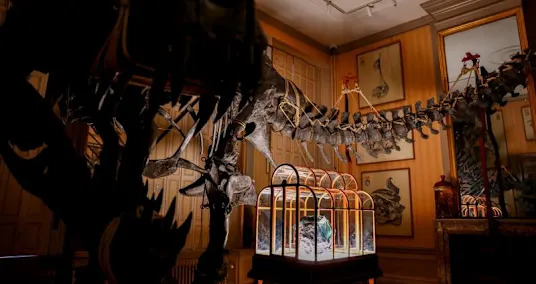
The teal-coloured bag was displayed on a rock in a cage under a replica of a T. rex at Amsterdam's Art Zoo museum where it will be auctioned next month at a reported starting price of more than half a million dollars.
Scientists behind the initiative said the material was developed using ancient protein fragments extracted from dinosaur remains that were inserted into an unidentified animal's cell to produce collagen that was turned into leather.
"There were a lot of technical challenges," said Thomas Mitchell, CEO of The Organoid Company, one of three companies behind the so-called "T. rex leather" bag.
Genomic engineering firm Organoid and creative agency VML, another of the firms behind the project, previously collaborated on creating a giant meatball in 2023 by combining the DNA of a woolly mammoth with sheep cells.
Che Connon, CEO of Lab‑Grown Leather Ltd. that worked on producing the leather for the handbag from the engineered collagen, said the T. Rex origin gave it extra "oomph".
"It's not just about a green alternative to leather, it's a technological upgrade," Connon said of lab-grown leather.
SCEPTICISM
Some scientists outside the project have expressed scepticism about the term "T. rex leather", saying material from other animals would be needed.
Dutch vertebrate paleontologist Melanie During, of the Vrije Universiteit Amsterdam, said collagen can persist in dinosaur bones only as fragmented traces that cannot be used to recreate T. rex skin or leather.
Thomas R. Holtz Jr., a paleontologist at the University of Maryland, similarly said any collagen identified in T. rex fossils comes from inside bone, not skin, and that even perfectly matching proteins would lack the larger‑scale fibre organization that gives animal leather its distinctive properties.
"I would say that when you do something new for the first time, there is always criticism," Mitchell said in response.
"And I think we're really grateful for that criticism. It's the bedrock of scientific exploration ... I think this is the closest anyone has gotten and will probably ever get to create something that's T. rex."
(Reporting by Charlotte Van Campenhout, Editing by Andrew Cawthorne)
LATEST POSTS
- 1
 Experience Is standing by: History's Most noteworthy Travelers
 - 2The most effective method to Pick the Right Volvo XC40 Trim for Your Way of life
- 3Five EU states press for windfall taxes on fossil energy sector
- 4Understanding Various Sorts of Financial balances: An Extensive Outline
- 5After harsh winter, Ukrainians find joy in releasing bats rescued from war




- Different Film Classification: What's Your Go-To for Amusement
- Instructions to Pick the Right Gold Speculation Procedure: Exploring the Market
- NASA Artemis II tracker: Crew less than 60,000 miles from moon ahead of Monday flyby
- Rick Steves Recommends This German Town's Castle Hotel With Rhine River Views
- Australia PM tries to reassure public as panic buying sees fuel demand surge 400% in some regions
- Meet the rescue team behind the astronauts as Artemis II's launch approaches
- 10 Fundamental Tips and Deceives to Lift Your Cell phone's Exhibition
- The Way to Recuperation: Defeating Dependence
- CPA Canada appoints eight directors as new governance model takes effect